Special Tools
 Belt Pouch
 Bolt cutters
 Cable Cutters ACSR
 Cable shears
 Cannon connectors / Slip Joint
 Circlip Pliers Set
 Combination plier set
 Combination pliers
 Combination Shears
 Compact bolt cutters CoBolt
 Concrete mesh cutters
 Control cabinet key
 Copper and stainless steel pipe cutters
 Cover cloths / Stand Mats
 Crimp assortments
 Crimping dies
 Crimping pliers
 Cutter for ribbon cable
 Cycle Pliers
 Diagonal Cutters for plastics
 Display panel
 Ear Clamp Pliers
 Electrical installation pliers
 Electricians' Gloves
 Electronic Diagonal cutter
 Electronics diagonal cutters
 Electronics Mounting Pliers
 End Cutting Nippers
 Extension sets
 External Circlip Pliers
 Flat Nose Pliers
 Grip pliers
 Hard protective tool case
 Hose Clamp Pliers
 Insertion - Compression Tool
 Insulated adjustable wrench
 Insulated hexagon socket
 Insulated screwdriver
 Insulating clamps
 Internal Circlip Pliers
 Long reach needle-nose pliers
 Mitre Shears
 Needle-Nose Pliers
 Notching pliers
 Open-End Wrenches
 Pipe Wrench
 Plastic pipe cutters
 Pliers Wrench
 Pont de Nemours
 Precision Tweezers
 Punch Lock Riveters
 Relay Adjusting Pliers
 Revolving Punch Pliers
 Round Nose Pliers
 Safety knives
 Sheet Metal Nibbler
 Side cutters
 Slip joint pliers
 Stripping Knives
 Stripping Tweezers
 Tetheredtool clip
 Tile pliers
 Tool set
 Universal stripping tools
 Vinyl Shears
 Water pump plier set
 Water pump pliers
 Wire Rope Cutter
 Wire stripping pliers
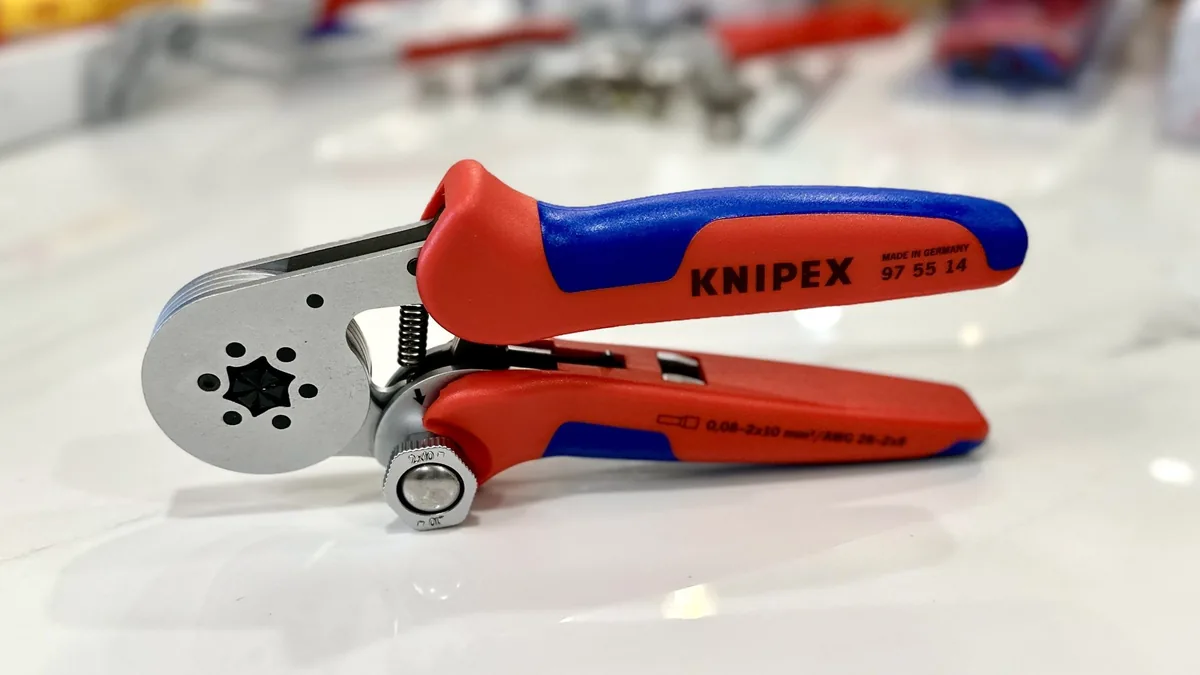
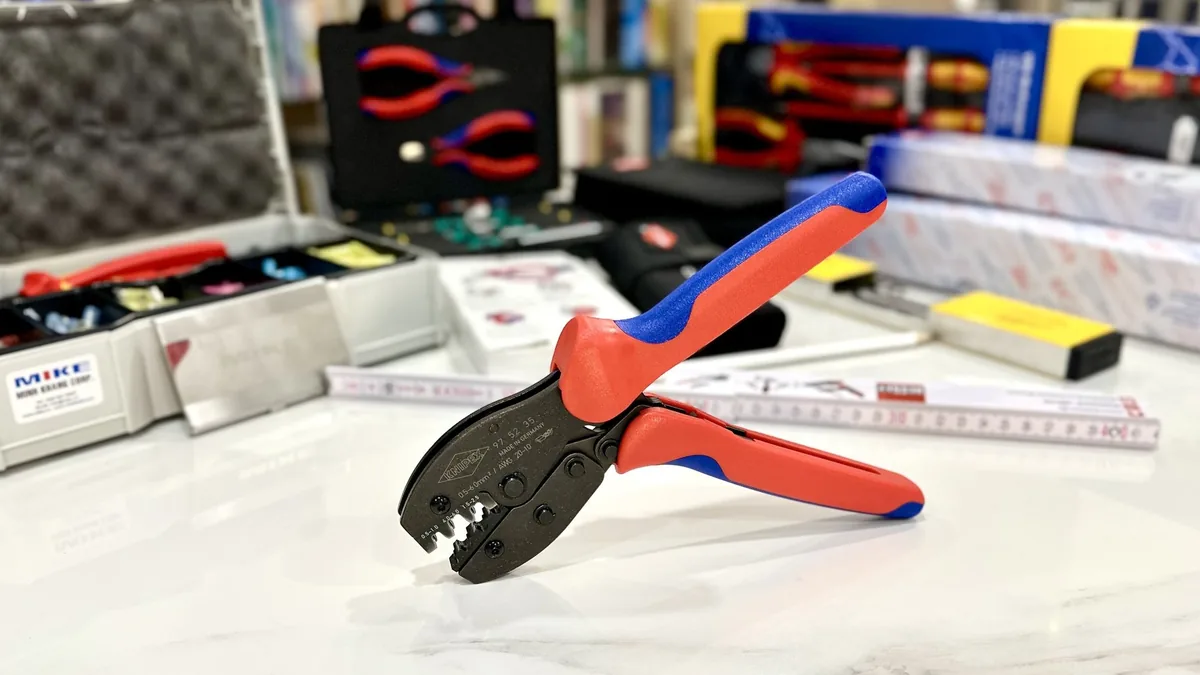
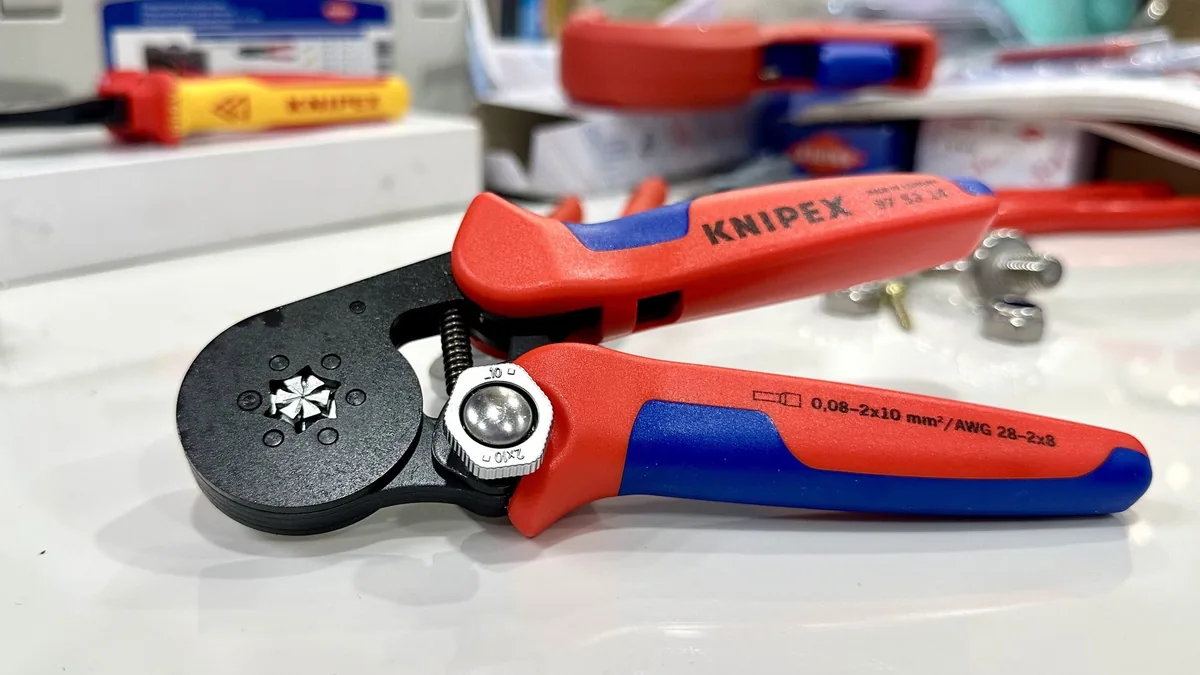
Crimping pliers are used to crimp terminals onto electrical conductors in industrial, residential and telecommunications installations. The product group includes DIN 46228 ferrule crimping pliers, RJ45 network crimping pliers, bootlace terminal crimping pliers and MC4 connector crimping pliers for solar power systems. Automatic series such as 97 53 14 and 97 53 04 recognize cross-sections from 0.08 to 16 mm² without manual die selection.
MultiCrimp series such as 97 33 01 integrate five die sets in one plier body, reducing the number of tools carried to the field. PreciForce series such as 97 52 67 DT measure crimping force precisely, meeting high requirements for connection reliability. Genuine Knipex products imported from the Federal Republic of Germany, with full warranty according to distributor policy.


Crimping pliers are used to crimp ferrules onto electrical conductors, creating stable connections between wires and terminal equipment in industrial, residential, and telecommunications installations. This product range includes ferrule crimping pliers for DIN 46228 tubular ferrules, RJ45 network connector crimping pliers, uninsulated ferrule crimping pliers, and MC4 connector crimping pliers for solar power systems. Self-adjusting models such as 97 53 14 and 97 53 04 recognize cross-sections from 0.08 to 16 mm² without manual die selection. The MultiCrimp range such as 97 33 01 integrates five die sets in one tool body, reducing the number of tools carried to the worksite. The PreciForce range such as 97 52 67 DT measures crimping force precisely, meeting high requirements for connection reliability. Genuine Knipex products imported from the Federal Republic of Germany, with full warranty according to distributor policy.
Crimping pliers are used to crimp ferrules onto electrical conductors, creating stable connections between wires and terminal equipment. This product range includes many specialized lines, from tubular ferrule crimping pliers according to DIN 46228 standard to RJ45 network connector crimping pliers, uninsulated ferrule crimping pliers, and MC4 connector crimping pliers for solar power systems.
Each line is designed for a specific ferrule group, ensuring uniform crimping force and correct connection shape according to technical requirements. In industrial electrical installation, residential, automation, and telecommunications, choosing the right type of crimping pliers directly affects connection quality, reducing the risk of poor contact and wire breakage.
Self-adjusting crimping pliers eliminate manual die selection, helping to increase construction speed and limit errors due to size confusion. The MultiCrimp range integrates multiple die sets in one tool body, reducing the number of tools needed on site. The PreciForce range focuses on crimping force precision, suitable for applications requiring high connection reliability.
Crimping pliers are divided into two main groups based on how the crimping die size is selected. The first group requires the user to rotate the plier head or change dies to match the ferrule cross-section. The second group automatically recognizes the cross-section and adjusts the crimping die without manual operation. This difference affects working speed, error potential, and the number of tools needed before construction.
The self-adjusting crimping pliers range includes 97 53 14, 97 53 04, 97 53 08, and 97 53 09. These codes handle tubular ferrules from 0.08 to 16 mm² according to DIN 46228 parts 1 and 4. The automatic mechanism eliminates the risk of incorrect crimping due to wrong die selection, especially useful when working with multiple ferrule sizes in the same project. Codes 97 55 04 and 97 55 14 also belong to the self-adjusting group, where 97 55 04 creates a square crimp while 97 55 14 creates a hexagonal crimp. The difference in crimp shape depends on the technical requirements of each application and connection standard.
The MultiCrimp range solves the problem of carrying multiple specialized pliers during field construction. Instead of preparing five pliers for five different ferrule types, users only need one plier body and quick die changes without tools. This approach reduces tool bag weight and shortens transition time between connector types.
Codes 97 33 01 and 97 33 02 belong to the MultiCrimp range, handling many common ferrule types in electrical and control work. Code 97 33 03 is specifically configured for solar applications, integrating three crimping die sets for MC4 connectors, MC4 Evo 2, uninsulated ferrules, and tubular ferrules. This design suits renewable energy installation teams, where both DC solar cable and AC control wire connections are needed. Code 97 33 LE is 250 mm long, providing greater leverage for large cross-section ferrules or harder materials.
Tubular ferrules are widely used in industrial electrical installation and automation, especially when connecting stranded wire to equipment terminal poles. DIN 46228 parts 1 and 4 specify dimensions, tolerances, and test methods for this ferrule type. Tubular ferrule crimping pliers create uniform crimping around the ferrule, holding wire strands firmly without excessive deformation.
Code 97 72 180 is 180 mm long, handling tubular ferrules from 0.25 to 16 mm². The plier body has three-component plastic handles, reducing hand fatigue during continuous operation. Codes 97 53 04 SB, 97 53 08 SB, 97 53 09 SB, 97 53 18, 97 53 18 SB, 97 53 19, and 97 53 19 SB belong to the self-adjusting Twistor range, supporting tubular ferrules in the same cross-section range. Codes 97 55 04 SB and 97 55 14 SB also handle tubular ferrules, where 97 55 04 SB creates a square crimp while 97 55 14 SB creates a hexagonal crimp.
Uninsulated ferrules have no outer insulation layer, commonly used in applications requiring space savings or when connecting to terminal poles that already have separate protective housing. The PreciForce range focuses on crimping force precision, ensuring connections achieve tensile strength and electrical conductivity according to standards.
Code 97 52 33 handles uninsulated ferrules from 0.5 to 10 mm², including tubular ferrules, compression ferrules, push-in connectors, and tube connectors. Code 97 52 34 specializes in open-barrel uninsulated ferrules, focusing on a specific application to control crimping force and crimp shape. Code 97 52 35 is for uninsulated open ferrules with 4.8 mm and 6.3 mm wide plugs. Code 97 52 36 handles insulated ferrule terminals, plug connectors, and tube connectors in the 0.5 to 6.0 mm² range. Code 97 52 23 is for large cross-section uninsulated ferrules from 16 to 25 mm², integrating a double-lever mechanism reducing hand force by 30% compared to standard crimping pliers.
RJ45 and RJ11 network connectors are used in telecommunications systems, internal networks, and data centers. Network connector crimping pliers integrate cutting and stripping blades, completing the entire process from cable preparation to connector crimping in one tool.
Code 97 51 10 is 190 mm long, handling Western plug RJ 11/12 and RJ 45 connectors, suitable for flat unshielded telephone wire and shielded network cable. Code 97 51 12 is 200 mm long, specializing in crimping RJ10, RJ11/12, and RJ45 connectors, integrating a resonance force transmission mechanism reducing hand fatigue. Code 97 51 13 supports standard 8P8C RJ45 connectors, usable for both shielded and unshielded network connectors. Codes 97 51 10 SB, 97 51 12 SB, and 97 51 13 SB are retail-packaged versions of the corresponding codes.
Micro plug connectors appear in electronics, automation, and measurement equipment applications, where installation space is limited and high precision is required. Micro plug crimping pliers apply parallel crimping technology, delivering uniform crimping performance across the entire connector width.
Code 97 54 24 is 190 mm long, specializing in D Sub type connectors. Codes 97 54 25 and 97 54 26 are also 190 mm long, handling other small connector types in the micro plug group. The slim design helps access tight positions that standard crimping pliers cannot reach.
MC4 and MC4 Evo 2 connectors are used in solar power systems, connecting DC cables from solar panels to inverters. Specialized crimping pliers for this connector type ensure crimps achieve tensile strength and current-carrying capacity according to connector manufacturer requirements.
Code 97 52 42 belongs to the PreciForce range, specifically configured for MC4 and MC4 Evo 2 connectors, handling solar panel cables with 4.0 and 6.0 mm² cross-sections. Code 97 33 03 belongs to the MultiCrimp range, integrating three crimping die sets for MC4, MC4 Evo 2 connectors, uninsulated ferrules, and tubular ferrules, suitable for installation teams needing to handle multiple connection types in the same renewable energy project.
Selecting crimping pliers depends on ferrule type, conductor cross-section, applicable technical standards, and frequency of use. Self-adjusting pliers suit work requiring handling of multiple ferrule sizes in a short time, reducing die change time and limiting errors. The MultiCrimp range suits mobile teams, reducing the number of tools to carry.
The PreciForce range suits applications requiring high connection reliability, where crimping force and crimp shape must strictly comply with standards. When working with tubular ferrules according to DIN 46228, check whether the pliers create a square or hexagonal crimp, as some terminal equipment requires a specific crimp shape. When crimping RJ45 or RJ11 network connectors, determine whether the cable is shielded or not to select suitable pliers.
When working with MC4 connectors, ensure the pliers are configured for the correct MC4 or MC4 Evo 2 version.

This website uses necessary cookies so the cart, sign-in and internal statistics work. If you agree, we turn on the Meta Pixel tool to improve our service quality. Privacy policy